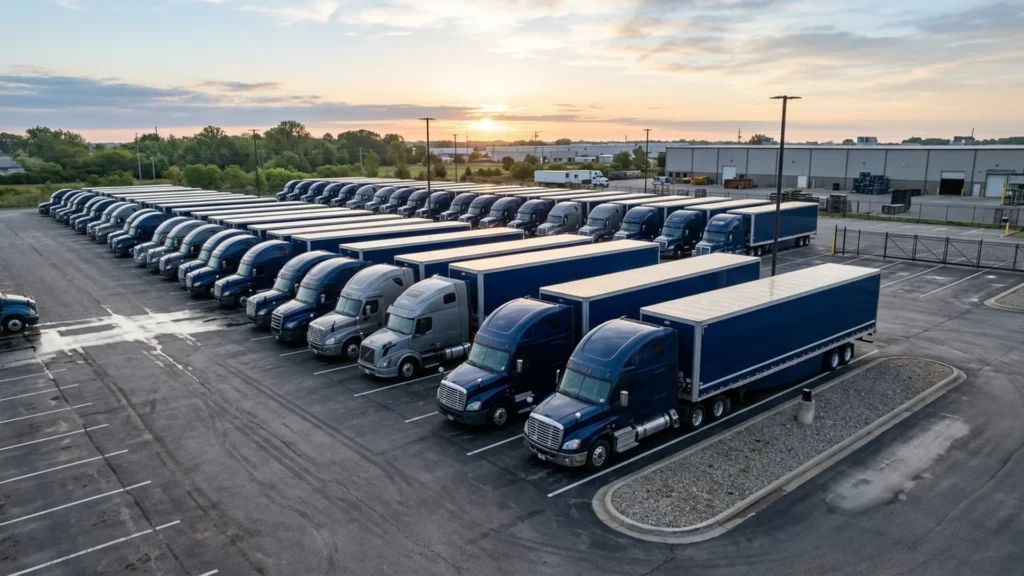
If your business runs a handful of box trucks or a yard full of tractor-trailers, you are not buying one policy. You are buying a stack of coverages that work together to protect the vehicles, the freight they haul, and the company behind them. People search for commercial truck fleet insurance expecting a single price, and that is the first thing to unlearn. A fleet program is a bundle, and its cost moves with the trucks you run, where they run, what they carry, and who is behind the wheel.
I write this as a licensed commercial-lines advisor in Hartford. I have placed coverage for owner-operators who grew into five-truck fleets and for established carriers running fifty units across multiple states. The patterns below come from real submissions and renewals. Nothing here is a quote, and nothing here replaces sitting down with a licensed agent who can see your loss runs, your driver list, and your operating authority. Rules change by state and under federal regulation, so treat the numbers as ranges to plan around, not promises.
This article focuses on the fleet and physical-damage side of the equation: insuring the trucks themselves as business property, the cargo they carry, and the gaps that open up when a unit is between dispatches. If you want a deeper look at the third-party injury and lawsuit exposure on its own, see our companion piece on commercial trucking liability coverage.
What commercial truck fleet insurance actually is
Fleet insurance is a way to cover multiple commercial vehicles under one program instead of writing a separate policy for every truck. Most carriers will let you put vehicles on a fleet basis once you run a certain number of units, often around three to five, though the threshold varies by insurer. The practical benefit is one renewal date, one set of policy terms, and underwriting that looks at your operation as a whole rather than truck by truck.
That last point matters more than the paperwork convenience. When an underwriter prices a fleet, they are betting on your operation: your safety culture, your hiring standards, your loss history over the last three to five years. A single bad driver or one large at-fault loss can move the whole program. A clean three-year record can pull it the other way. Fleet pricing rewards consistency, which is why the way you run the business shows up directly on the premium.
It helps to think of a fleet program as a chassis with several coverages bolted on. The chassis is the policy. The coverages are auto liability, physical damage on the trucks, motor truck cargo, and the situational pieces like non-trucking liability and trailer interchange. You can add general liability for the yard, an umbrella for catastrophic claims, and property coverage for a terminal. The rest of this guide walks each one.
What a fleet policy covers, coverage by coverage
No two fleets buy the identical stack, but the core pieces show up on almost every program. Here is what each one does and why it sits on the policy.
Commercial auto liability
This is the legally required base and the part nobody skips. It pays for bodily injury and property damage you cause to other people when a truck is at fault: the medical bills, the other vehicle, the lawsuit. For interstate for-hire carriers, federal financial-responsibility rules generally set a minimum of $750,000 in liability, and most operations carry $1 million combined single limit because shippers, brokers, and lenders expect it. Higher minimums apply to certain cargo, including some hazardous materials, where the federal floor rises sharply. Confirm the exact figure for your authority and commodity with your agent, because it is set by regulation and varies by what you haul.
Liability is the coverage most likely to generate a catastrophic claim, which is why it drives so much of the premium and why the liability angle deserves its own discussion. For a focused breakdown of that exposure, our general liability and trucking liability hub goes deeper than I can here.
Physical damage: collision and comprehensive on the trucks
This is the heart of the fleet-property side and the reason this article exists. Physical damage coverage pays to repair or replace your own trucks and trailers when they are damaged. Collision covers impact: hitting another vehicle, a guardrail, a loading dock. Comprehensive covers almost everything else, including theft, fire, vandalism, falling objects, flood, and animal strikes.
If your trucks are financed or leased, the lender will require physical damage coverage and will want to be listed as a loss payee. Even on units you own outright, a single new tractor can run well into six figures to replace, so dropping collision and comprehensive to save a few dollars is a gamble that rarely pays off for a working fleet. Physical damage is priced largely off the stated value of each unit, so the newer and more expensive your equipment, the more this line costs. You choose a deductible per occurrence, commonly $1,000 to $5,000, and a higher deductible lowers the premium in exchange for more out-of-pocket risk on each claim.
Because your trucks are a major business asset, it is worth coordinating this with the rest of your commercial property coverage so equipment, a terminal, and tools are all accounted for under one logic rather than scattered across mismatched policies.
Motor truck cargo
Cargo insurance covers the freight you are hauling, not your truck. If a load is damaged, destroyed, or stolen while in your care, this coverage responds. It is separate from physical damage for a simple reason: the truck and the cargo are two different assets with two different values. Many shippers and brokers will not tender a load without proof of cargo coverage, often $100,000 in limits, sometimes more depending on what you move.
Cargo pricing tracks the type and value of what you carry. General dry freight is cheaper to insure than refrigerated loads, electronics, or anything with a high theft profile. Read the exclusions closely. Many cargo policies limit or exclude certain commodities, refrigeration breakdown, or unattended-vehicle theft, and those gaps are where claims get denied. Match your cargo limit to the real value of a typical load and ask your agent about reefer breakdown coverage if you run temperature-controlled freight.
Non-trucking liability and bobtail coverage
These two cover the in-between moments. Non-trucking liability applies when a driver is using the truck without a dispatch, for personal use, while leased to a motor carrier. Bobtail coverage applies when the tractor is running without a trailer, often deadheading back after a delivery. Both fill gaps that a standard liability policy may not cover when the truck is off-dispatch. If your fleet leases drivers or operators to another carrier, or if your owner-operators run under your authority part-time, these endorsements close a real hole. They are inexpensive relative to the exposure, which is exactly why they get overlooked until a claim falls in the gap.
Trailer interchange and other useful add-ons
Trailer interchange covers damage to trailers you pull but do not own, typically under a written interchange agreement. If your operation swaps trailers with other carriers, this protects you when you are responsible for someone else’s equipment. Beyond that, fleets commonly add general liability for non-driving exposures like a slip-and-fall in the yard, an umbrella or excess policy to sit above the auto liability limit for catastrophic claims, and hired and non-owned auto if employees ever drive rented or personal vehicles for the business. None of these are mandatory in the way liability is, but each one closes a specific gap that a working fleet runs into eventually.
What it costs: real ranges for 2026
Here is the honest version. There is no flat price for fleet insurance, and any source that gives you one is selling something. What I can give you is the range underwriters are working within this year, based on current market submissions. Single commercial trucks commonly land somewhere between roughly $400 and $1,200 per month for the truck alone, before cargo and physical damage, with box trucks at the low end and hazmat tankers at the very top. Industry data this year puts the average around $400 to $650 per month for $1 million in liability on a typical truck, with type of truck and cargo swinging it dramatically.
On a fleet basis, most small fleets see a fully loaded program, meaning liability plus physical damage plus cargo, land somewhere around $750 to $2,500 or more per truck per month, depending on radius, cargo, limits, deductibles, driver quality, and loss history. New ventures without an established loss record sit at the high end because the underwriter has no track record to price against. An established fleet with clean loss runs and good driver retention sits at the low end. The table below puts those per-truck ranges into fleet-level annual budgets so you can plan.
| Fleet size | Typical fully-loaded annual range | What pushes you to the high end |
|---|---|---|
| 5 trucks | $45,000 – $150,000+ | New authority, long-haul radius, high-value or hazmat cargo, young drivers |
| 10 trucks | $90,000 – $300,000+ | Recent at-fault losses, $1M+ limits, low deductibles, mixed driver records |
| 25 trucks | $225,000 – $750,000+ | National operating radius, refrigerated or specialized freight, poor CSA scores |
| 50 trucks | $450,000 – $1.5M+ | Catastrophic claim history, hazmat, high turnover, urban garaging ZIPs |
Notice how wide those bands are. A clean five-truck fleet hauling local dry freight can sit near the bottom of its row while a brand-new five-truck operation running coast-to-coast reefer sits near the top of the row above it. The fleet size sets the rough scale. Everything else sets where you land inside it.
A worked example
Take a Connecticut-based fleet of eight dry-van tractors running a regional 500-mile radius, three years in business, one minor at-fault claim on the books, drivers averaging six years of experience. A program for that operation might carry $1 million in auto liability, physical damage on tractors valued around $120,000 each with a $2,500 deductible, and $100,000 in motor truck cargo. In today’s market that operation might budget somewhere in the neighborhood of $9,000 to $16,000 per truck per year fully loaded, which lands the fleet roughly in the $72,000 to $128,000 annual range. Now change one input: swap the regional dry freight for refrigerated long-haul, and the same eight trucks can jump toward the top of the ten-truck row above. Same number of units, very different premium, because radius and cargo did the work.
What drives the price
Underwriters are pricing the probability and severity of a claim. Almost everything that moves a fleet premium maps back to one of those two questions. Here are the levers that matter most.
- Type of truck and cargo. This is the single biggest factor. A box truck and a hazmat tanker are not in the same universe. Hazardous cargo alone can add roughly 90 to 110 percent to a liability premium compared with standard freight.
- Operating radius. Local and regional fleets generally pay less than long-haul and national operations. More miles and more states mean more exposure and more variation in road conditions.
- Driver records and experience. Clean motor vehicle records, years of experience, and low turnover pull premiums down. A single driver with violations or a serious at-fault loss can move the whole fleet.
- Loss history. Underwriters look at three to five years of loss runs. Frequency hurts, but severity hurts more. One large claim can shadow a renewal for years.
- Limits and deductibles. Higher liability limits cost more. Higher deductibles on physical damage and cargo cost less in premium but more out of pocket per claim.
- Garaging location. Where the trucks are based matters. Dense urban ZIP codes and high-litigation states price higher than rural areas. State rules and court environments vary widely.
- Years in business. New ventures pay a premium for having no track record. After three claim-free years, doors start to open with more carriers and better pricing.
- Vehicle age and value. Physical damage is priced off stated value, so newer, pricier equipment costs more to insure, even as it may be safer to operate.
Fleet versus single-truck coverage
If you run one or two trucks, you are usually writing individual commercial auto policies. The shift to a true fleet basis tends to happen around three to five units, depending on the carrier. The difference is not only administrative. On a fleet program, the underwriter prices your operation as a unit and spreads risk across the vehicles, which can smooth out the effect of one truck or one driver. You also get a single renewal, consistent terms across the fleet, and often the option to add or remove units mid-term without rewriting a policy.
The flip side is that fleet underwriting scrutinizes the whole operation. Your driver list, your safety program, your CSA scores, and your loss runs all come under one lens. A small fleet with one bad actor can pay for it across every unit. For most growing operations the trade is worth it: by the time you are running five or more trucks, managing five separate policies with five renewal dates is its own kind of risk. If you are still deciding whether fleet treatment fits your stage, comparing programs by your specific trade can help, and our coverage-by-trade guide is a good place to start.
How to lower your fleet premium
You have more control over this number than most owners assume. Underwriters reward operations that lower their own risk. Here is where the real savings come from, in rough order of impact.
- Tighten driver hiring and keep records clean. A documented hiring standard, MVR checks, and low turnover are the strongest lever you have. Clean records can save a meaningful share of premium, often cited in the 20 to 40 percent range for fleets that maintain them.
- Run telematics and dashcams. Many carriers offer credits for monitored fleets because the data lets them price more accurately and the cameras help defend against fraudulent claims. The defense benefit alone can pay for the hardware after one disputed accident.
- Bundle coverages with one carrier. Placing auto liability, physical damage, and cargo together often earns a multi-line discount, commonly in the 10 to 20 percent range, and it removes the gaps that appear when coverages live on different policies.
- Raise deductibles where you can absorb the risk. Moving from a $1,000 to a $2,500 or $5,000 physical-damage deductible lowers premium. Only do this if your cash position can handle the larger out-of-pocket hit on a claim.
- Build time in business and a clean loss run. Three or more years without claims opens up more carriers and better rates. This one takes patience, but it is the most durable discount there is.
- Right-size your limits and values. Insuring trucks above their actual cash value wastes premium, and carrying cargo limits far above your typical load value does too. Match coverage to real exposure and revisit it every renewal.
- Invest in a safety program. Documented driver training, maintenance logs, and a safety policy give underwriters something concrete to credit and lower your claim frequency at the same time.
A practical note: shop the program through an agent who works the trucking market, and start the renewal conversation 60 to 90 days out. Fleet placements take time, and a rushed renewal almost always costs more than a planned one.
How to choose a fleet policy
When you compare programs, do not lead with price. Lead with whether the coverage actually matches how you operate, then compare price among the options that do. A cheaper policy with the wrong cargo limit or a non-trucking gap is not cheaper after one denied claim.
Work through these questions with your agent before you sign anything. What are the liability limits, and do they meet your authority’s federal and state minimums plus what your brokers and shippers require? Is physical damage written on stated value or actual cash value, and are your lenders listed correctly? Does the cargo limit cover your highest-value typical load, and what commodities or scenarios are excluded? Are non-trucking and trailer-interchange exposures handled if they apply to you? What is the claims process and how fast does the carrier pay, since downtime on a truck is lost revenue? Finally, is the insurer financially sound and experienced in commercial trucking specifically, not just commercial auto in general?
Cost matters, but it is the last filter, not the first. For help thinking through quotes and what a realistic number looks like for your operation, our cost and quotes guide walks through the comparison process. And whatever you do, get the actual program reviewed by a licensed commercial agent and confirm the terms with the carrier in writing. The general guidance here is a starting point. Your authority, your state, and your loss history decide the rest.
For broader context on how business insurance fits together, the Insurance Information Institute and the U.S. Small Business Administration both offer plain-language overviews worth reading before you talk to an agent. For the federal financial-responsibility minimums tied to your operating authority and cargo, check your requirements directly with the Federal Motor Carrier Safety Administration, since those figures are set by regulation and vary by commodity.
Frequently asked questions
How many trucks do I need before I qualify for fleet insurance?
Most insurers let you write coverage on a fleet basis once you run roughly three to five vehicles, though the exact threshold varies by carrier. Below that, you are usually writing individual commercial auto policies. As you grow, fleet treatment gives you one renewal date, consistent terms, and underwriting that prices the operation as a whole. Ask a few carriers where their fleet threshold sits, because it differs.
Is physical damage coverage required on my trucks?
It is not legally required the way liability is, but if your trucks are financed or leased, the lender will require collision and comprehensive and will want to be named as a loss payee. Even on units you own outright, replacing a modern tractor can cost six figures, so most working fleets carry it. The premium is based on the stated value of each unit and the deductible you choose.
Does cargo insurance cover my trucks too?
No. Motor truck cargo covers the freight you are hauling, not the vehicle. Physical damage covers the truck and trailer. They are separate coverages for separate assets, which is why both appear on most fleet programs. Match your cargo limit to the real value of a typical load, and read the exclusions, since many policies limit certain commodities or unattended-vehicle theft.
How much does fleet insurance cost per truck?
For a fully loaded program with liability, physical damage, and cargo, small fleets commonly land somewhere around $750 to $2,500 or more per truck per month, depending on cargo, radius, limits, deductibles, driver records, and loss history. New ventures sit at the high end. Established fleets with clean loss runs sit lower. These are planning ranges, not quotes. Your actual premium depends on your operation, and a licensed agent and the carrier set the real number.
What is the fastest way to lower my fleet premium?
The biggest levers are clean driver records and a documented hiring standard, telematics and dashcams that many carriers credit, and bundling liability, physical damage, and cargo with one carrier for a multi-line discount. Raising deductibles helps if you can absorb the larger out-of-pocket hit. Building three or more claim-free years is the most durable saver of all. Confirm available credits with your agent and carrier.