Salon insurance is the bundle of business policies that protects a hair, beauty, or barber shop from the everyday risks that come with chemicals, sharp tools, foot traffic, and clients who expect a perfect result. A botched color correction, a slip on a wet floor, a stolen set of clippers, or an employee who burns a hand on a hot iron each points to a different policy, and no single coverage handles all of them. I am Marcus Bedroix, and I spend a lot of time pulling salon owners back from two mistakes: buying nothing because the shop is small, or buying one policy and assuming it covers everything. Neither ends well when a claim shows up.
This guide lays out what salon insurance covers, what each piece costs, who needs which policy, and the gaps that catch booth renters and new owners off guard. I will map specific salon disasters to the exact coverage that pays, because that is the part most pages skip. None of this is legal advice; insurance rules and license requirements vary by state, so confirm the specifics with a licensed insurance agent or broker before you buy.
What Salon Insurance Covers
Salon insurance is not one product. It is a stack of separate coverages, and a real policy usually combines several. The core pieces are:
- General liability pays when a client or visitor is physically hurt or their property is damaged in your shop. The classic example is a slip-and-fall on a wet floor, or a client’s coat ruined by spilled dye.
- Professional liability, also called errors and omissions, pays when your service itself causes harm or a client claims the result was negligent. A chemical burn from relaxer, a botched color, an allergic reaction to a product you applied, these are professional liability claims, not general liability.
- Commercial property covers your physical stuff: stations, chairs, dryers, mirrors, inventory, and tools, against fire, theft, and many kinds of damage.
- Business owner’s policy (BOP) bundles general liability and commercial property at a discount, and is the usual starting point for an established salon.
- Workers’ compensation covers employees who are injured on the job, which in a salon means burns, slips, and repetitive-strain injuries.
- Cyber liability matters more every year as salons run online booking, store client contact details, and take card payments.
The single most important distinction here is general versus professional liability. General liability handles the customer who trips. Professional liability handles the customer who hates her highlights and says the chemical service damaged her hair. Owners routinely buy general liability, skip professional liability, and then find their worst-case claim, the service gone wrong, is the exact thing they are not covered for. The Insurance Information Institute has a plain-language rundown of which types of business insurance you need that reinforces why service businesses carry both.
Match the Disaster to the Policy
The fastest way to see your gaps is to map real salon incidents to the coverage that responds. Here is the cheat sheet I give new owners.
| What goes wrong | Policy that pays |
|---|---|
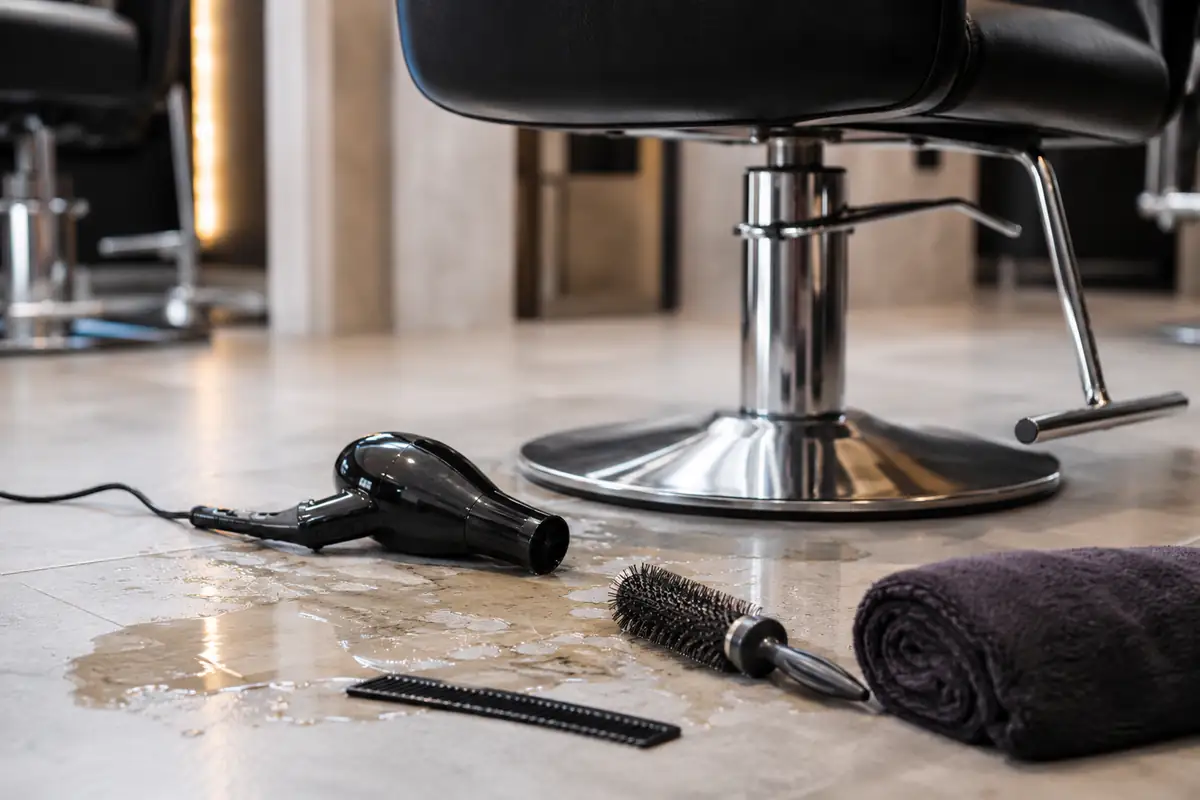
| Client slips on a wet floor and breaks a wrist | General liability |
| Color service causes a chemical burn or hair loss | Professional liability (E&O) |
| Fire damages your stations and inventory | Commercial property / BOP |
| Tools and clippers stolen overnight | Commercial property / BOP |
| Stylist burns a hand on a flat iron | Workers’ compensation |
| Booking system breach exposes client data | Cyber liability |
| Fire shuts the shop for six weeks | Business income (often inside a BOP) |
Notice how many different policies show up. That is the whole point: a salon faces a wide spread of risks, and a thoughtful program covers the body, the building, the service, the staff, and the data. The good news is that bundling most of this into a BOP plus a professional liability policy plus workers’ comp covers the large majority of real claims at a manageable price.
How Much Does Salon Insurance Cost
Here are the real ranges, the part the carrier sales pages leave out. For a small salon, expect:
- General liability on its own: roughly $400 to $800 a year.
- A business owner’s policy (general liability plus property): roughly $500 to $1,500 a year, depending on property values and location.
- Professional liability for the salon: roughly $500 to $1,200 a year, higher if you do heavy chemical or treatment work.
- Workers’ compensation: priced per $100 of payroll by job class, so it scales with your team size.
- Cyber liability: often a few hundred dollars a year added to a small-business package.
Your number moves on the usual levers: location, number of employees, annual revenue, the value of your equipment, the limits you choose, your claims history, and whether you own business vehicles. A two-chair shop in a low-cost state with a clean record sits at the bottom of these ranges; a busy multi-stylist salon doing color and treatments in a high-cost metro sits well above. For the full picture of how these policies fit a small operation, our guide to the best small business insurance fit walks through bundling and limits.
Booth Renters and Independent Stylists: The Gap Nobody Warns You About
This is the section the big carrier pages ignore, and it is where I see the most uncovered claims. If you rent a chair or booth inside someone else’s salon, the salon’s policy does not automatically cover you. The salon’s general liability covers the salon’s premises and the salon owner, not your professional work. If a client sues over a service you performed, that is your claim, and without your own professional liability policy you are paying out of pocket.
Booth renters and independent stylists need, at minimum, their own professional liability coverage, and usually a small general liability policy too, because the salon owner’s lease almost always requires the renter to carry it and name the salon as an additional insured. Independent stylist policies are inexpensive, often a few hundred dollars a year, and they are non-negotiable if you work for yourself inside someone else’s space. Treating the host salon’s insurance as your safety net is one of the most expensive assumptions in the industry.
Certificates of insurance and lease requirements
Whether you rent a booth or lease a whole storefront, expect to be asked for a certificate of insurance. A landlord, a booth-rental salon owner, or a mall will require proof that you carry general liability at a stated limit, commonly $1,000,000 per occurrence, and that you list them as an additional insured. Build that requirement into your shopping from the start so your policy limits and endorsements match the lease, rather than scrambling to amend coverage after you sign.
Chemical Services and Why Professional Liability Is Non-Negotiable
The single biggest source of real salon lawsuits is the chemical and treatment side of the business. Color, bleach, relaxers, keratin treatments, perms, waxing, and lash work all carry the risk of burns, allergic reactions, hair breakage, and skin damage. These are professional liability claims, full stop, and they are the claims most likely to land in the thousands of dollars once you add a lawyer.
If your shop does any chemical or treatment work, professional liability is not optional, it is the policy that protects your livelihood. Two practical habits cut both your risk and your premium pressure: run a patch test before color and chemical services on new clients, and keep a signed consent and service record for treatments. Documentation that a client was warned and consented is often what turns a potential payout into a quick dismissal. Because professional liability for service businesses is priced and structured much like E&O elsewhere, our breakdown of errors and omissions insurance cost is a useful companion for understanding how these premiums move and what drives them up.
Workers’ Compensation and Your Team
The moment you hire your first stylist, assistant, or front-desk employee, workers’ compensation almost certainly becomes mandatory under your state’s law. Salons are hands-on, hot-tool, chemical-heavy workplaces, and on-the-job injuries are common: burns, slips, cuts, and repetitive-strain problems from years of standing and styling. Workers’ comp pays the medical bills and a portion of lost wages, and it shields you from being sued directly by an injured employee. The federal Occupational Safety and Health Administration’s resources for workers are a good reference for the safety practices that reduce these injuries in the first place.
Booth renters complicate this. A genuine independent contractor is generally not your employee for workers’ comp purposes, but states apply their own tests, and misclassifying a worker who is really an employee can leave you owing back premium and an uncovered claim. If your arrangement blurs the line, confirm the worker’s status with your state board before you assume comp does not apply.
What Salon Insurance Does Not Cover
Knowing the exclusions keeps you from a false sense of safety. A standard salon program leaves out several things owners assume are covered. Wear and tear and gradual deterioration of equipment are never covered; property insurance pays for sudden events like fire and theft, not for a dryer that simply died of age. Intentional or fraudulent acts by you or your staff are excluded. Professional liability will not pay for a bodily injury that belongs to general liability, and general liability will not pay for a service complaint that belongs to professional liability, which is exactly why you need both rather than one. Flood and earthquake are typically excluded from standard property coverage and require separate policies in at-risk areas. And employee theft or cash disappearance is not covered unless you add an employee dishonesty endorsement.
The other quiet gap is coverage limits that have not kept up with your shop. A salon that bought a property limit of $20,000 five years ago and has since added stations, a wash unit, and retail inventory may be badly underinsured at replacement cost today. Review your limits every renewal against what it would actually cost to rebuild and re-equip the shop, not what you paid years ago.
Common Salon Claims and What They Cost
Concrete examples make the coverage real. A client with an undisclosed sensitivity has an allergic reaction to a color product, requires medical treatment, and files a professional liability claim; between treatment costs and a lawyer, these can run from a few thousand dollars to well into five figures. A keratin or relaxer service goes wrong and a client alleges hair breakage and scalp burns, the kind of claim that settles in the thousands once documentation is weak. On the general liability side, a client trips over a cord or slips near the wash station and breaks a bone, producing a medical and possibly a liability payout that a small shop could not absorb from cash flow.
Property claims hit just as hard. A small electrical fire after hours can destroy stations, mirrors, dryers, and a season of retail inventory, easily tens of thousands of dollars to replace, plus weeks of lost income while you rebuild. That last piece, the lost income, is why business income coverage belongs in any serious salon policy: the property claim rebuilds the shop, but only business income coverage replaces the revenue you lose while the doors are closed. Owners who carry property but skip business income survive the fire and then get sunk by the six weeks of zero revenue that follow.
How to Buy the Right Salon Policy
Start by listing your actual services and your actual assets, then match coverage to both. A simple barber shop with no chemical work and rented equipment needs less than a full-service salon doing color, treatments, and retail with $40,000 of stations and inventory. From there, decide between assembling separate policies and buying a BOP that bundles the common ones, which is usually cheaper for an established shop.
When you compare quotes, look past the premium at the limits, the deductible, and whether professional liability is included or sold separately, because that is the coverage owners most often leave off by accident. Confirm the policy meets your lease’s certificate-of-insurance requirements. Ask about add-ons that fit a salon specifically: business income for the weeks you cannot open after a loss, employee dishonesty if you handle cash, and cyber if you run online booking. The U.S. Small Business Administration’s guide to getting business insurance is a solid neutral checklist to keep beside you while you shop.
Frequently Asked Questions
Do I need salon insurance if I rent a booth?
Yes. The salon owner’s policy covers the salon and the owner, not your professional services. As a booth renter you need your own professional liability coverage, and usually a small general liability policy too, since most booth-rental leases require it and ask you to name the salon as an additional insured.
What is the difference between general and professional liability for a salon?
General liability covers physical injury and property damage, like a client slipping on a wet floor. Professional liability covers harm caused by your service itself, like a chemical burn or a botched color. A salon doing any chemical work needs both, because each handles a completely different type of claim.
How much does salon insurance cost?
A small salon usually pays roughly $500 to $1,500 a year for a business owner’s policy, plus $500 to $1,200 for professional liability, plus workers’ compensation priced on payroll once you have staff. Your exact cost depends on location, services, revenue, equipment value, and claims history.
Is workers’ compensation required for a salon?
In most states, yes, once you have employees. The trigger varies by state, with many requiring it from the first hire. Genuine booth renters who are independent contractors are usually outside the requirement, but misclassification carries real penalties, so confirm worker status with your state board.
Does salon insurance cover stolen tools and equipment?
Yes, commercial property coverage, usually inside a business owner’s policy, covers theft of your tools, equipment, and inventory, along with fire and many other kinds of damage. Confirm the limit is high enough to actually replace your stations, dryers, and clippers at current prices.
Will a landlord require proof of insurance?
Almost always. Landlords and booth-rental salon owners typically require a certificate of insurance showing general liability at a stated limit, often $1,000,000 per occurrence, and ask to be named as an additional insured. Match your policy to the lease requirement before you sign.
Bottom Line
Salon insurance works only when you treat it as a stack, not a single purchase. General liability handles the client who falls, professional liability handles the service that goes wrong, property coverage protects your tools and stations, and workers’ compensation covers your team. The biggest mistakes are skipping professional liability when you do chemical work and, for booth renters, assuming the host salon’s policy covers you when it does not. Build your coverage around your actual services, your equipment value, and your lease requirements, and revisit it whenever you add staff or new treatments. Because requirements and license rules vary by state and change over time, use this as a starting point and confirm the specifics with a licensed insurance agent or broker before you buy.