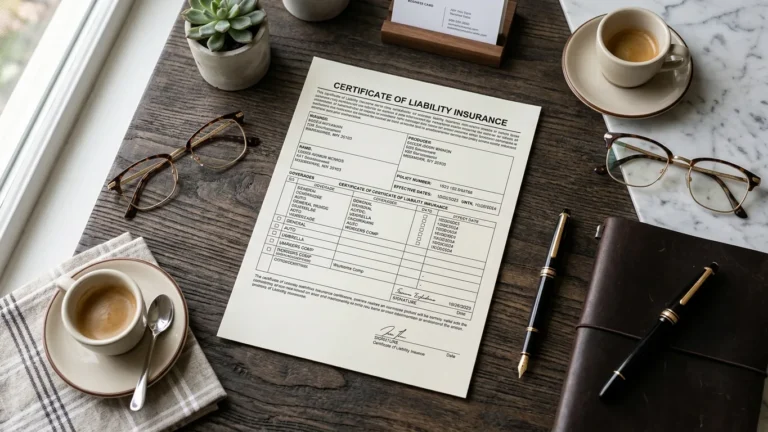
If your business publishes, broadcasts, or distributes content, the biggest legal risk you carry probably isn’t a slip-and-fall. It’s a sentence. A line in a client’s ad, a stock photo nobody cleared, a podcast guest who names a competitor, or a blog post that crosses from opinion into a statement someone calls defamatory. Media liability insurance exists to defend and pay for exactly these claims: defamation, libel and slander, copyright and intellectual property infringement, invasion of privacy, and advertising injury tied to what you put out into the world.
I write commercial-lines policies in Connecticut, and I see the same gap over and over. A business owner assumes their general liability policy “covers advertising stuff,” signs nothing else, and finds out during a demand letter that the coverage they leaned on was narrow, riddled with exclusions, or capped far below the legal bill. This guide breaks down what media liability insurance actually covers, where it stops, who needs it, how it lines up against general liability and professional liability (E&O), what it costs in real ranges, and how to size your limits without guessing. None of this is a quote or a guarantee. Coverage and exclusions vary by carrier and by the exact wording in your policy, so treat this as a map, not the territory, and confirm the specifics with a licensed agent before you buy.
What media liability insurance is
Media liability insurance is a specialized form of professional liability built for content. It responds when a third party claims your published or broadcast material caused them harm. The “media” in the name is broad on purpose. It reaches text, images, audio, video, social posts, email campaigns, websites, advertising creative, and the content you produce on behalf of clients.
Most media liability policies are written on a claims-made basis. That matters more than people expect. A claims-made policy responds to claims first made and reported during the policy period, not to incidents that simply happened during it. If you publish something in 2024, get sued in 2026, and let your policy lapse in between, you may have no coverage at all unless you carried continuous coverage with a matching retroactive date or bought tail coverage. General liability, by contrast, is usually written on an occurrence basis. This single structural difference trips up more buyers than any exclusion does, so it is worth asking your agent to spell out the retroactive date in writing.
The policy pays two buckets: defense costs (attorney fees, court costs, expert witnesses, investigation) and indemnity (settlements and judgments you become legally obligated to pay). Many content claims never reach a verdict. They get expensive in the defense phase, which is precisely where this coverage earns its keep, because legal defense fires up even when a claim is meritless.
What media liability insurance covers
The exact grant of coverage depends on the carrier, but a well-built media liability policy typically responds to claims of:
- Defamation, libel, and slander. A published statement that damages a person’s or company’s reputation.
- Copyright infringement. Using text, images, music, or video you didn’t have the rights to. This is the workhorse claim for agencies and content shops.
- Trademark and trade dress infringement. Using a protected mark, logo, or distinctive look in your content or advertising.
- Invasion of privacy. Publishing someone’s likeness, private facts, or image without consent, or putting them in a false light.
- Plagiarism and misappropriation of ideas. Claims that you lifted someone’s protected work or pitched concept.
- Advertising injury and disparagement. Harm caused by your ad content, including disparaging a competitor’s goods or services.
- Negligent publication and content errors. Mistakes in what you published that a third party relied on to their detriment, depending on policy wording.
Some carriers bundle useful extras: crisis management and public-relations support to manage reputational fallout, breach-of-contract defense in limited circumstances, and coverage that explicitly extends to social platforms, blogs, podcasts, and email marketing rather than just “traditional” print and broadcast. Read the schedule of covered media types. A policy written in 2012 language can leave modern channels in a gray zone.
What media liability insurance excludes
Every policy is a set of promises wrapped in a set of exceptions. The common exclusions to expect:
- Intentional or knowingly wrongful acts. If you knew the content was false or infringing and ran it anyway, expect the carrier to deny.
- Bodily injury and property damage. Those are general liability’s job, not this policy’s.
- Patent infringement. Almost always excluded. Patents are a separate, specialized risk.
- Breach of contract in many standard forms, though some policies carve back limited coverage.
- Employment disputes (handled by employment practices liability) and cyber events like data breaches (handled by a cyber policy).
- Prior known claims and circumstances you were aware of before the policy started, and anything before your retroactive date.
- Fraud, criminal acts, and bodily-harm-causing content in most forms.
Exclusions are where wording wins or loses cases, so don’t rely on a summary, including this one. Ask for the specimen policy and read the exclusions section before you bind.
Who needs media liability insurance
If your revenue depends on content you create or distribute, you are in the target zone. The clearest candidates:
- Advertising and marketing agencies producing creative for clients, where a single campaign can trigger a trademark or false-advertising claim.
- Publishers, bloggers, and online media putting out a steady stream of articles and images.
- Content creators, YouTubers, and podcasters who name people and brands, use clips, and run sponsorships.
- PR and communications firms drafting statements and pitching stories on behalf of clients.
- Video and film production companies dealing with likeness rights, music licensing, and footage clearance.
- Graphic designers, copywriters, and freelancers whose deliverables become someone else’s published asset.
- Companies with high-volume social and email marketing, even if media isn’t their core business.
A useful test: if a stranger could read, watch, or hear something you produced and feel wronged by it, you have media exposure. The more content you publish, the more eyes on it, and the more brand names and people you reference, the higher that exposure climbs. The U.S. Small Business Administration recommends assessing your risks and reassessing coverage as you grow, which for a content business means revisiting media exposure every renewal. You can compare typical needs by trade on our coverage by trade guide.
Media liability vs general liability vs professional liability (E&O)
This is the question that causes the most expensive mistakes, so it deserves room. The three policies overlap at the edges and leave gaps in the middle.
General liability (GL) covers bodily injury, property damage, and a slice of content risk through its “personal and advertising injury” coverage. That sounds reassuring until you read it. GL’s advertising injury grant is narrow. It typically covers libel, slander, and some copyright in “your advertisement,” and it carries its own exclusions for things like infringement in the title of your work, breach of contract, and claims by businesses in the media and advertising trade. So an agency that publishes content for a living often finds GL’s advertising-injury coverage partly or fully excluded for its core operations. GL is necessary, but it was never designed to be a content-business’s primary content protection. The Insurance Information Institute notes that business-owner and general liability policies don’t cover professional liability, which is one reason content firms layer on separate coverage. You can read more about GL on our general liability hub.
Professional liability, also called errors and omissions (E&O), covers financial harm caused by mistakes in your professional services: missed deadlines, faulty advice, work that fell short of the standard a client paid for. For many media businesses, E&O and media liability are sold together as a blended “media professional liability” policy, because a single bad campaign can be both a service failure (E&O) and a content claim (media). Where they are separate, E&O answers the “we did the job badly” claim and media liability answers the “what you published harmed a third party” claim. Our professional liability and E&O page goes deeper on that side.
Media liability is the purpose-built content policy. It covers the defamation, IP infringement, privacy, and advertising-injury claims arising from what you publish, with broader terms and fewer trade-specific exclusions than GL’s advertising-injury grant. For a content business, it is the policy that matches the actual exposure.
Here is how the three stack up at a glance.
| Feature | General Liability (GL) | Professional Liability (E&O) | Media Liability |
|---|---|---|---|
| Primary risk covered | Bodily injury, property damage, limited advertising injury | Financial harm from professional mistakes | Defamation, IP infringement, privacy, advertising injury from content |
| Defamation / libel / slander | Limited, within “advertising injury,” with exclusions | Generally no | Yes, core grant |
| Copyright / trademark infringement | Narrow, often excluded for media/ad trades | Generally no | Yes, core grant |
| Invasion of privacy | Limited | No | Yes |
| Missed deadlines / faulty work | No | Yes | Often included in blended media/E&O forms |
| Policy basis | Usually occurrence | Usually claims-made | Usually claims-made |
| Typical small-business cost | Roughly $400 to $900 per year | Roughly $800 to $3,000 per year | Roughly $800 to $3,000 per year for small firms; far more at scale |
Cost figures above are general market ranges for illustration, not quotes. Your actual premium depends on your specifics.
What media liability insurance costs
Pricing varies widely because “media business” covers everyone from a solo copywriter to a national broadcaster. Treat the following as ranges, not quotes. Carriers price your exact risk individually, and the only real number is the one on a bound policy.
- Solo creators, freelancers, and small agencies. Many small media and advertising businesses land around a median of roughly $75 to $80 per month, near $900 to $950 per year, for a policy with a $1 million per-occurrence and $1 million aggregate limit and a $1,000 deductible. A large share of small buyers pay under $100 a month, and a meaningful slice pay under $50.
- Profession drives the spread. Lower-risk work prices lower. Graphic designers often average around $70 per month, while publishers that also print run higher, around $180 per month, for similar coverage. Higher publishing volume and broader audiences push premiums up.
- Mid-sized firms producing more content or carrying higher limits commonly pay in the $5,000 to $8,000 per year range for $1 million to $2 million in coverage.
- Large publishers and broadcasters with heavy output and multi-million-dollar limits can pay $20,000 to $50,000 per year or more.
If you want help thinking through quotes and structure for an LLC or small firm, our cost and quotes resource walks through the process.
A worked example
Say you run a six-person digital marketing agency in Hartford billing about $700,000 a year. You publish client ads across paid social, run two client blogs, and produce a weekly branded podcast. A national retailer sends a demand letter claiming one of your campaigns disparaged its product and used a near-identical tagline to a registered trademark. Your GL carrier points to the media-and-advertising-trade exclusion and declines the bulk of it. Without media liability, you’re funding defense out of operating cash. With a $1 million media liability policy and a $2,500 deductible, the carrier appoints defense counsel, covers the legal bill as it runs, and the realistic question becomes your deductible plus the time lost, not whether the lawsuit ends your agency. The premium for that protection might run a few thousand dollars a year. The defense alone on a contested IP claim can run well into five or six figures. That math is the whole argument.
What drives your premium
Underwriters look at the things that make a content claim more likely or more expensive:
- Type and volume of content. A high-output news site is riskier than an occasional B2B blog.
- Audience size and reach. More readers and viewers mean more potential plaintiffs.
- Subject matter. Investigative journalism, comparative advertising, political content, and anything naming real people or brands raises the risk profile.
- Revenue and business size. Larger operations generally pay more.
- Limits and deductible. Higher limits cost more; a higher deductible lowers premium but raises your out-of-pocket on a claim.
- Claims history. Prior media or IP claims push pricing up and can trigger exclusions.
- Controls and clearance process. A documented review, fact-checking, and rights-clearance process is a discount lever, not just good hygiene.
How to choose your limits
There is no universal right number, but there is a sane way to reason about it. Start from what a realistic worst-case claim against you would cost to defend and resolve, not from the cheapest limit on the menu.
- Solo creators and small freelancers often start at a $1 million per-occurrence / $1 million aggregate limit, the most common small-business choice. It covers the typical single defamation or copyright claim.
- Growing agencies and publishers with multiple clients or higher visibility frequently move to $2 million or more, because one campaign can spawn several claims and the aggregate gets consumed fast.
- High-output or high-profile media carry $5 million and up, sometimes layered with excess coverage.
Three things to weigh beyond the headline number. First, check whether defense costs erode the limit or sit outside it; a “defense within limits” policy gives you less indemnity than the number suggests. Second, match your retroactive date to when you started publishing, so older content stays covered. Third, look at client contract requirements. Many brands and platforms now require their vendors to carry a minimum media or media/E&O limit, and that contractual floor often decides your number for you. When in doubt, ask a licensed agent to model a couple of scenarios against your actual contracts rather than picking a limit off a chart.
How to lower your cost
You can bring premium down without gutting the coverage:
- Build and document a content-review process. Fact-checking, legal review of sensitive pieces, and a rights-clearance log for images, music, and footage all reduce risk and signal it to underwriters.
- Raise your deductible if you have the cash reserves to absorb a larger first-dollar hit on a claim.
- Bundle thoughtfully. A blended media/E&O policy, or a package with your GL, can price better than standalone policies bought piecemeal.
- Keep continuous coverage. Lapses on a claims-made policy create gaps and can reset your retroactive date, which costs you more than any small premium you saved.
- Use contracts and licenses. Written model releases, license records, and indemnity clauses with subcontractors lower your exposure and your premium over time.
- Shop the specialist market. Carriers that focus on media and tech risk often price and word these policies better than generalists. An independent agent can compare several at once.
The bottom line
If you publish for a living, media liability insurance isn’t a nice-to-have bolted onto general liability. It’s the policy that matches your actual risk: the defamation claim, the copyright takedown that becomes a lawsuit, the privacy complaint, the trademark fight over an ad. General liability gives you a thin, exclusion-heavy slice of content coverage. E&O covers your professional mistakes. Media liability covers the harm your content does to third parties, which for a content business is the exposure that can write the biggest check. Price it as a range, size your limits to a realistic worst case and your client contracts, and read the exclusions before you sign. Then have a licensed agent confirm the wording against your specific operation, because the policy language, not this article, is what pays a claim.
This article is general information for U.S. businesses and is not insurance, legal, or financial advice. Coverage terms, exclusions, availability, and pricing vary by carrier, state, and policy wording. Cost figures are illustrative ranges, not quotes or guarantees. Always read your policy and consult a licensed insurance agent before making decisions.
Frequently asked questions
Does general liability insurance already cover defamation and copyright claims?
Partly, and often not enough. General liability includes a “personal and advertising injury” grant that can cover libel, slander, and some copyright tied to your advertising. But that grant is narrow and carries exclusions, including one that commonly applies to businesses in the media and advertising trade and to infringement claims beyond your own advertisement. For a content-driven business, those exclusions can leave your core operations exposed, which is why a dedicated media liability policy exists. Confirm your specific GL wording with your agent.
Do solo content creators and podcasters really need media liability insurance?
If you name people or brands, use third-party images, music, or clips, or run sponsorships, you carry real exposure even as a one-person operation. A single copyright or defamation claim can cost more to defend than years of premium. Many solo creators start with a $1 million limit. Whether it makes sense for you depends on your content, audience size, and risk tolerance, so weigh it with a licensed agent rather than assuming you’re too small to be sued.
How much does media liability insurance cost?
It varies widely. Many small media and advertising businesses pay roughly $75 to $80 a month, near $900 to $950 a year, for a $1 million policy, though graphic designers often pay less and publishers that print pay more. Mid-sized firms commonly run $5,000 to $8,000 a year, and large publishers and broadcasters can pay $20,000 to $50,000 or more. These are general ranges for illustration, not quotes. Your premium depends on your content, volume, limits, and claims history.
Is media liability the same as errors and omissions (E&O) insurance?
They overlap but aren’t identical. E&O, or professional liability, covers financial harm from mistakes in your professional services, such as missed deadlines or faulty work. Media liability covers harm your published content causes to third parties, such as defamation or infringement. Many carriers sell them blended as a single “media professional liability” policy, because one bad project can trigger both. Ask whether your quote is media-only, E&O-only, or a combined form.
What does media liability insurance not cover?
Common exclusions include intentional or knowingly wrongful acts, bodily injury and property damage, patent infringement, many breach-of-contract claims, employment disputes, cyber and data-breach events, and anything before your policy’s retroactive date or known to you beforehand. Exclusions vary by carrier and policy wording, so the only reliable answer is the one in your specific contract. Read the exclusions section and have a licensed agent walk you through it before you buy.