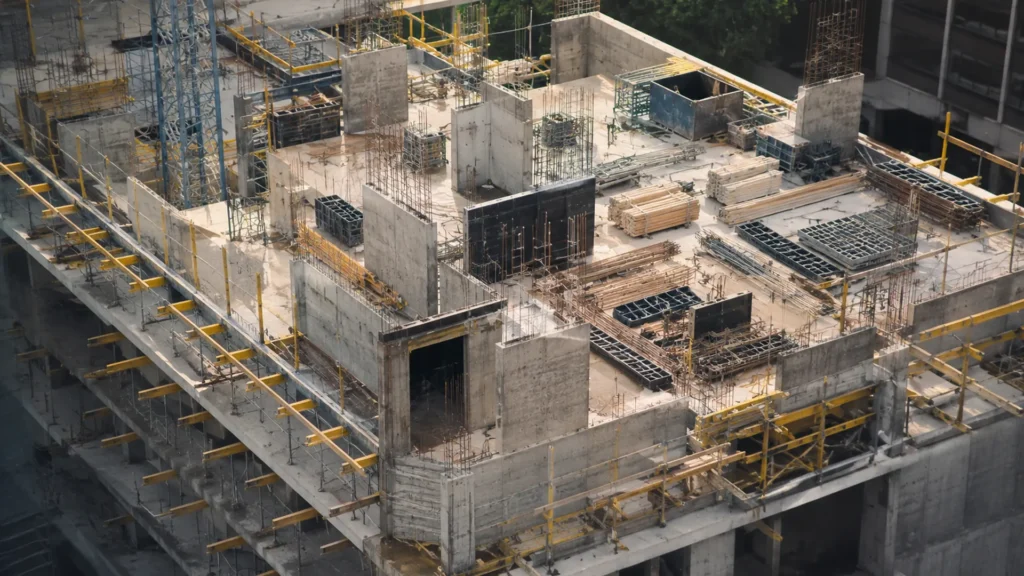
Course of construction insurance protects a building and its materials while the project is being built or renovated, the window when a standard property policy will not respond. You will also hear it called builder’s risk insurance; the two terms describe the same coverage. It pays for fire, theft, vandalism, wind, and other sudden damage to the structure, the lumber, the fixtures, and the equipment on the job site before the project is finished. I am Marcus Bedroix, and the most expensive mistake I see on construction projects is everyone assuming someone else bought this policy, then discovering after a fire that nobody did. The half-built structure falls into a coverage gap that neither the homeowner’s policy nor the contractor’s general liability fills.
This guide covers what course of construction insurance includes, what it leaves out, what it costs, who should hold the policy, and the occupancy trap that voids coverage at the worst moment. None of this is legal advice; policy terms and state rules vary, so confirm the particulars with a licensed insurance agent or broker before you rely on any coverage.
What Course of Construction Insurance Covers
The policy is a specialized property coverage built around an active job site. A standard form covers direct physical loss to:
- The structure under construction or renovation itself.
- Building materials and supplies, whether on-site, in transit, or temporarily stored off-site.
- Foundations, fixtures, and installed equipment.
- Temporary structures like scaffolding and fencing, and often debris removal after a covered loss.
The covered perils typically include fire, lightning, explosion, theft, vandalism, and wind, the sudden events that can wipe out months of progress overnight. The reason the coverage exists at all is that homeowner and commercial property policies carry exclusions for property under construction or vacant during major work. The standard policy assumes a finished, occupied building; a framed-out shell with open walls and stacked materials is a different risk, and it needs its own policy. The Insurance Information Institute has a clear overview of builder’s risk insurance if you want the formal definition alongside this practical walk-through.
Soft costs and delay coverage
Here is the piece most articles mention only in passing. A serious loss does not just cost you the burned lumber; it costs you time, and time costs money. Soft cost coverage and delay-in-completion endorsements pay for the financial fallout of a delay caused by a covered loss: extra loan interest, additional architectural and engineering fees, lost rental income on a project you planned to lease, real estate taxes, and permit renewal costs incurred because the timeline slipped. On a commercial or income-producing project, these soft costs can rival the direct property damage. If a fire sets a 12-month build back by 4 months, the extra interest and lost rent over those months is real money that only a soft cost endorsement recovers. Always ask whether soft costs are included or available, because the base policy often covers only the hard property loss.
What It Does Not Cover

Course of construction insurance is property coverage, not liability coverage, and that line is where projects get exposed. The standard policy will not pay for:
- Injury to a third party or damage to someone else’s property, which belongs to the contractor’s general liability policy.
- Injury to workers on the site, which belongs to workers’ compensation.
- Faulty workmanship, design defects, and the cost to fix the contractor’s mistakes.
- Normal wear and tear, rust, corrosion, and mechanical breakdown.
- Flood and earthquake, unless added by specific endorsement.
- Employee theft and contractual penalties.
The faulty-workmanship exclusion catches owners off guard. If a wall collapses because it was built wrong, the policy generally will not pay to redo the work, though it may pay for resulting damage to other covered property. And because the policy is silent on liability, a construction project needs a full program around it. The contractor’s general liability covers bodily injury and third-party property damage, workers’ compensation covers the crew, and design professionals carry their own errors and omissions coverage. Builder’s risk fills only the property-during-construction slot. For the broader picture of how these business policies fit together, our guide to the best small business insurance fit shows where each one lives.
How Much Does Course of Construction Insurance Cost
The cost question is the one carrier pages dodge, so here is a usable rule of thumb. Course of construction premiums generally run somewhere between 1 percent and 4 percent of the total completed value of the project. A $400,000 build at a 2 percent rate would carry a premium in the neighborhood of $8,000 for the construction term, though the real number swings with the variables below.
The premium is driven by:
| Factor | Effect on premium |
|---|---|
| Total completed value | The base the rate is applied to; bigger project, higher premium |
| Project type | New ground-up vs renovation; some renovations rate higher |
| Construction materials | Frame construction rates higher than masonry or fire-resistive |
| Project duration | Longer builds mean more exposure time |
| Location | Flood, wildfire, and high-crime areas cost more |
| Site security | Fencing, cameras, and lighting can earn credits |
Set the policy limit to the total completed value of the project, not the land value and not the partial value mid-build. If you insure to a number lower than completed value, a co-insurance penalty can cut your payout on even a partial loss. The whole point is that the policy ramps up with the structure, so the limit must reflect the finished cost.
Who Should Buy the Policy and Hold It
This is the question that causes the most confusion and the most uncovered losses, and the top guides list the parties without resolving it. The candidates are the property owner, the general contractor, and sometimes a developer, with the lender named as a loss payee. Any of them can buy course of construction insurance because each has an insurable interest in the project. The practical answer comes down to your contract.
On many custom-home and commercial projects, the owner buys the policy because the owner carries the financial risk and the loan. On spec and developer-driven projects, the general contractor often buys it and folds the cost into the project budget. What matters is that the contract spells out exactly who buys it, what limit, and who is named, so there is no gap and no duplicate. The lender will almost always require itself to be listed as a loss payee or mortgagee, because the bank wants its money protected if the half-built collateral burns. If you are the owner, do not assume the contractor bought it; get the certificate of insurance in hand and read the named insureds before the first nail goes in.
What a Real Construction Loss Looks Like
The value of this coverage becomes obvious the moment you picture an actual loss. A residential build is framed and dried-in, with cabinets, flooring, and fixtures delivered and stacked inside, when an overnight electrical fault sparks a fire. The structure is heavily damaged and most of the stored materials are destroyed. Without course of construction insurance, the owner eats the cost of rebuilding the framing and re-buying every material already paid for, on top of the loan still owed on the project. With the policy in place, the property loss is covered up to the limit, and if soft cost coverage was added, the extra loan interest and the months of delay are recovered too.
Theft is the other claim I see constantly, because an active job site is a target. Copper wire, appliances, lumber, and tools disappear from sites that are open and unguarded, sometimes the same week they are delivered. Course of construction covers theft of covered materials, which is why insurers reward fencing, lighting, and cameras with premium credits: the controls that lower the carrier’s risk also lower yours. A site that gets cleaned out twice before completion is both a covered loss and a signal to tighten security before the next delivery arrives. The lesson in both stories is timing. The exposure peaks exactly when the building is most vulnerable, half-finished and full of value, and that is the window the policy is built to cover.
The Occupancy Trap That Voids Coverage

Course of construction insurance is temporary by design. Coverage starts when work begins and ends at a defined point, typically when the project is complete, when a certificate of occupancy issues, or when the building is occupied or put to its intended use, whichever comes first. That endpoint is a trap.
If you move in, start using the space, or even let a tenant take partial occupancy before the policy is converted to a permanent property policy, you can void coverage on the very loss you were worried about. Many policies restrict or suspend coverage once occupancy begins. The fix is to line up your permanent commercial property or homeowner’s policy to take effect the moment the builder’s risk term ends, with no gap. And if the project runs long, which they often do, contact your agent before the policy expires to extend it; a lapsed builder’s risk policy on an unfinished project is the same uncovered exposure as never having bought one. The U.S. Small Business Administration’s guide to getting business insurance is a useful neutral reference while you coordinate the handoff between policies.
New Construction Versus Renovation
Not every project rates the same way, and the new-build versus renovation distinction matters more than the carrier pages let on. New ground-up construction has a clean, predictable exposure: the value rises steadily as the structure goes up, and the insurer can rate it against the total completed value with confidence. Renovation and remodel projects are trickier because there is already an existing structure with its own value, and the policy has to handle both the work being done and the building it is being done to. Some renovations rate higher precisely because cutting into an occupied or recently occupied building introduces fire and water risks that a vacant new-build does not have.
If you are renovating, be clear with your agent about whether the existing structure needs to be insured under the builder’s risk policy or whether it stays on the owner’s existing property policy, because a gap or an overlap here is common and expensive. A partial renovation where the owner keeps using part of the building is the hardest case of all, since occupancy and construction are happening at the same time, and that arrangement needs careful structuring so the active occupancy does not undercut the construction coverage. When the lines blur, a project that also carries design or contractor professional exposure may need its own errors and omissions coverage layered in; our guide to errors and omissions insurance cost explains how that professional coverage is priced alongside the property side.
How Course of Construction Fits a Contractor’s Program
For a contractor, course of construction is one line in a stack of policies, not the whole picture. The crew is covered by workers’ compensation. Third-party injuries and property damage are covered by general liability. The vehicles hauling materials are covered by commercial auto, and a contractor running a fleet should look hard at that exposure, much like the issues we cover in our breakdown of trucking liability insurance. Builder’s risk slots in to protect the project property itself during the build. Treating any one of these as a substitute for the others is how a contractor ends up with a covered loss in one category and a catastrophic gap in another.
One structural choice worth raising with your agent is whether to write a single-project policy or, for a contractor running several builds at once, a reporting-form or blanket builder’s risk program that covers multiple projects under one policy. A single-project policy is simplest for an owner or a contractor with one job. A blanket or reporting form fits a builder with a steady pipeline, since it automatically picks up new projects as they start instead of forcing a fresh policy for every site. The reporting form requires you to report values periodically and keep them current, but it removes the risk of starting a job that nobody remembered to insure. For a busy contractor, that automatic pickup is often worth more than any premium difference, because the most expensive builder’s risk claim is always the one on the project that was never added to a policy in the first place.
Frequently Asked Questions
Is course of construction insurance the same as builder’s risk?
Yes. Course of construction and builder’s risk are two names for the identical coverage. Both protect a structure and its materials against sudden physical loss while the project is being built or renovated, and both end when the project reaches completion or occupancy.
Who pays for course of construction insurance?
It depends on the contract. On owner-driven projects the property owner often buys it; on developer or spec projects the general contractor frequently does and builds the cost into the budget. The key is that the contract names exactly who buys it so there is no gap or duplicate, with the lender listed as a loss payee.
Does course of construction insurance cover injuries on the job site?
No. It is property coverage, not liability coverage. Worker injuries are covered by workers’ compensation, and third-party injuries or property damage are covered by the contractor’s general liability policy. Course of construction pays only for physical loss to the project property itself.
How much does course of construction insurance cost?
As a rule of thumb, premiums run roughly 1 percent to 4 percent of the total completed value of the project. A $400,000 build at 2 percent would be around $8,000 for the construction term. The exact cost depends on project type, materials, duration, location, and site security.
When does course of construction coverage end?
Coverage ends at a defined point, usually completion, issuance of a certificate of occupancy, or when the building is occupied or put to use, whichever comes first. Occupying the space before converting to a permanent property policy can void coverage, so line up the permanent policy to start with no gap.
Does it cover flood or earthquake damage?
Not under the standard form. Flood and earthquake are typically excluded and must be added by specific endorsement, which matters a great deal for projects in flood-prone or seismic areas. Ask for these endorsements where the location warrants it.
Bottom Line
Course of construction insurance fills the exact gap a standard property policy leaves open: the months a building sits half-finished, full of materials and exposed to fire, theft, and weather. The policy covers the structure and materials but not liability, not workers, and not faulty workmanship, so it lives inside a larger program rather than replacing one. Get three things right and you avoid the common disasters: insure to the total completed value, write the contract so everyone knows who holds the policy, and coordinate the end of the builder’s risk term with the start of permanent coverage so occupancy never opens a gap. Because policy terms and state rules vary and change over time, use this as a starting point and confirm your specific coverage with a licensed insurance agent or broker before you build.